Blog

  • Nine Failures and a Lot of Motivation

    Out of school learning relies heavily on intrinsic motivation; engaging in a task for pure satisfaction. Motivation can help us pursue a goal, but it doesn’t necessarily lead to success. It involves activation (starting), persistence (continuing) and intensity (effort) (Cherry, 2026). In our attempt to make the perfect French macaron, we tested all three.

    The following macaron adventure became a lesson in what it takes to learn a new skill outside a formal learning environment. What started as a personal challenge turned into a journey of much trial and error, frustration, and eventually learning from an expert. We discovered that motivation and persistence matter, but so does feedback, experience, and mentorship when it comes to learning.

    Learning on Our Own

    Making French macarons is not a feat for the faint of heart. They are notoriously unforgiving and quite finicky. Temperature or humidity variables, along with too many or too few strokes when mixing the batter, may result in cracked tops, hollow or sunken shells or no feet. These fancy French delicacies can frustrate even the most seasoned of bakers. But my husband and I were motivated and ready for the challenge! We’d recently mastered sourdough bread, so how hard could macarons really be?

    Armed with a recipe from famed New York Times baker, Claire Saffitz, and a great sense of confidence, we set off on our first attempt.

    Failure! Flat, wrinkly tops.

    No worries, we tried again making extra sure to follow the recipe to a “t”.

    Failure!

    Persistence. Our third attempt sent us to the website of the New York Times baker where we watched her video as we matched her techniques step by step.

    Failure!

    New recipe.

    Failure!

    Different video.

    Failure!

    Consult with a friend who has attempted these tricky treats.

    Failure!

    Nine attempts on our own. And nine failures.

    How could we be falling so short of success when we were so closely following the recipes and mirroring videos step by step? Were we learning something new with each attempt, or repeating the same mistakes without recognizing it?

    Photo by Steve Sneed

    The Turning Point

    Our independent and valiant efforts hadn’t produced success, so we signed up to take a French macaron class at Le Chat Gourmet with a professional chef.

    We, along with about 10 other eager bakers, were able to observe the chef in real time as she demonstrated the art of sifting, mixing, and folding the batter with precision. She explained what she was doing at each step and described the science behind why she was doing it. We asked questions during her demonstration and she responded.

    When it was our turn to make the batter, we received feedback, “The batter is too thick.” “It should be glossy”, “It should run off the spatula like lava”.

    Feedback!

    The feedback from the chef helped us to see where our home attempts had gone awry. This was a good example of how informal learning doesn’t necessarily mean learning on your own. By the end of the class, we had made a variety of gorgeous French macarons! But would we be able to transfer this knowledge when we returned home to our own kitchen?

    This experience highlighted what was missing when we worked on our own: feedback from someone with experience! While we were motivated, and quite persistent, when we were learning independently, we had to troubleshoot what went wrong and how to modify our technique on our own.

    Making Connections

    Out of school learning takes place outside of formal school settings. In our case, learning took place in our kitchen as we read through recipes and watched online videos. It also took place in the community as we were mentored by a local chef. We were voluntarily learning, we set our own goals, we chose our own resources, allowed ourselves flexibility in when we wanted to bake, and critiqued our own results. Authentic learning took place through obtaining knowledge and skills through meaningful real-world engagement (Williams, 2026). My husband and I had set a challenge for us to make close-to-perfect macarons. No instructor was telling us to do this, nor would we receive a grade. We simply wanted to challenge our baking skills. But, after nine failed attempts, I did start to wonder if we were wasting our time.

    As I reflect on the macaron experience, I think those failures helped give us a foundation to build on when we worked with an experienced chef. Our previous attempts helped us to recognize our mistakes and better understand the chef’s feedback. From a sociocultural learning standpoint, the chef provided us with scaffolding by demonstrating how to fold the batter, and providing us with feedback to help us build on what we had already learned. Without those earlier failed experiences, we may not have fully appreciated the chef’s advice. We connected our experiential learning with the chef’s feedback so we could apply what we learned, and we made these macarons independently:

     Photo by Kristi Sneed

    Voluntary out of school learning requires more than motivation and persistence. It also involves feedback, reflection and recognizing when a different approach is needed.

    References:

    Cherry, K. (2026, July 4). Motivation: The driving force behind our actions. verywell mind.

    https://www.verywellmind.com/what-is-motivation-2795378

    Williams, J.P. (2026, September 23). What is authentic about ‘authentic learning’? Times Higher Education.

    https://www.timeshighereducation.com/campus/what-authentic-about-authentic-learning
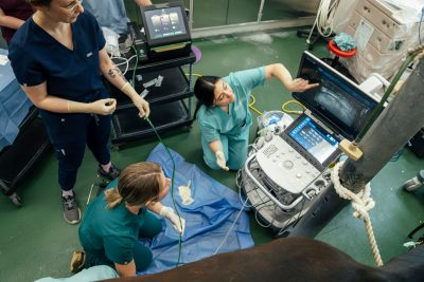
  • “See One, Do One, Teach One”: Sociocultural Learning in Veterinary Nursing Education

    Photo: MSU Veterinary Medical Center

    “See one, do one, teach one” is a common saying and learning approach in veterinary medicine. It essentially means, observe an expert performing a task, practice this task under the guidance and supervision of someone more experienced, and, once you’ve established competency, teach the task to a less experienced learner. 

    While the “see one, do one, teach one” learning approach isn’t a part of Vygotsky’s teachings, I did see some connections between this familiar veterinary teaching approach and several concepts within Vygotsky’s Sociocultural Learning Theory.

    Lev Vygotsky was a Russian psychologist who viewed learning as a social process. He believed that learning occurred through social interactions with others. He suggested that cognitive growth is shaped through interactions with our society and people that have more knowledge than the learner, such as parents, peers and teachers (Cherry, 2025).

    One of Vygotsky’s central ideas was that of the More Knowledgeable Other (MKO) (Cherry, 2024). The MKO is someone with more knowledge or experience in a particular field and who is able to support and guide a learner as they develop new knowledge and skills. The MKO might be peers, instructors, or more experienced community members that share their knowledge with the learner.

    Vygotsky also discussed the Zone of Proximal Development. This is the gap between what a learner can do on their own and what they can do with guidance from someone more knowledgeable (Vygotsky, 1978) and (Cherry, 2023). Through social interactions and scaffolding, or temporary support provided to the learner, the learner can gradually move towards greater independence.

    When I think about the “see one, do one, teach one” approach through this lens, I can see how each step illustrates Vygotsky’s theory.

    See one: The learner observes someone more knowledgeable performing a task in a social and contextual environment.

    Do one: The learner works through their Zone of Proximal Development with guidance and support while the scaffolding is gradually removed, allowing the learner to complete what they once were not capable of performing.

    Teach one: Once the learner has developed the knowledge and skills, they can now guide and support someone with less experience. They now become the More Knowledgeable Other for another less experienced learner.

    Vygotsky’s Sociocultural Learning Theory made me wonder about the order in which we teach our veterinary nursing students.

    Currently, our students begin their curriculum in the classroom where they are introduced to foundational knowledge and concepts. As they progress through the curriculum, we begin helping them to transfer their knowledge to models and eventually to live animals. Their final year is spent on the clinic floor working side by side with veterinary students, senior veterinary nurses, doctors, and clients.

    Students seem to get more energized once they start working with live animals on the clinic floor. Here they are working with real patients, with real problems, surrounded by real members of the veterinary team. They are connecting their knowledge and skills and seeing how they actually fit into their chosen profession.

    So, I wondered:

    Why do we wait until the end of their curriculum to create this social, contextual experience for our students? Instead, I wonder what would happen if we flipped the order of their curriculum.

    What if students were allowed to observe and interact alongside veterinary professionals in the clinic BEFORE the end of their formal classroom knowledge?

    This doesn’t mean we no longer engage students in a didactic classroom setting. Veterinary nursing is a hands-on profession where knowledge, skills, safety and evidence-based decision making are essential.

    Could earlier access to the clinic floor and interactions with real veterinary professionals (MKOs) help our student learners grasp a better understanding of their future profession?

    Could this provide a richer dialogue between the teacher and the student learner once they reach the classroom where foundational knowledge was then introduced? Students would then have more to talk about, have more questions to ask and have made more connections.

    Vygotsky’s Sociocultural Learning Theory has made me think about the structure of our current veterinary nursing curriculum. If students become more engaged and make stronger learning connections when surrounded by people and experiences that are real, perhaps  we need to move our “see one, do one, teach one” earlier in our students’ learning.

    References:

    Vygotsky, L.S. (1978) Interaction between learning and development in M. Cole, V. John-Steiner, & E. Souberman (Eds.) Mind in Society: The development of higher psychological processes (pp. 79-91). Harvard University Press

    https://convivenciajt.weebly.com/uploads/2/6/7/3/26732425/vygotsky_1978_cap_6._interaction_between_learning_and_development.pdf

    Cherry, K. (2023, July 6). How Vygotsky defined the Zone of Proximal Development. verywell mind.

    https://www.verywellmind.com/what-is-the-zone-of-proximal-development-2796034

    Cherry, K. (2025, February 7). Lev Vygotsky’s life and theories. verywell mind.

    https://www.verywellmind.com/lev-vygotsky-biography-2795533

    Cherry, K. (2024, July 12). What is sociocultural theory? verywell mind.

    https://www.verywellmind.com/what-is-sociocultural-theory-2795088

  • Hello to My MALXD Cohort

    I’m so excited to get to know you all and forge ahead on our MALXD journey!